Phasics
- Wavefront, MTF and QPI measurement solutions
- Products
- Applications
- Markets
- Company
- Contact us
June 4, 2026
In laser wakefield acceleration (LWFA), the experimental recipe looks deceptively clean: focus a 100-TW-class ultrashort laser pulse into a supersonic gas jet, and within femtoseconds, you have an underdense plasma target, a relativistic electron beam, and as recent experiments have confirmed, a burst of intense terahertz (THz) radiation. The physics, in principle, follows predictably from the laser parameters.
In practice, it rarely does.
Shot-to-shot instability, beam pointing jitter, and irreproducible THz output are familiar frustrations for anyone running high-power laser experiments. The laser system is usually the first suspect, but more often than not, the culprit is something harder to see: the plasma density profile.
The Hidden Variable Behind Reproducibility
Plasma density is not just a background condition in LWFA , it is a primary driver of the interaction dynamics. Even small fluctuations in the local electron density alter the effective refractive index of the medium, which in turn modifies how the laser self-focuses, how the wakefield cavity forms behind it, and whether the conditions are right for electrons to be injected into the accelerating phase at all.
This sensitivity propagates all the way to the output. Electron beam divergence, energy spread, and pointing stability, as well as the energy and spatial profile of the emitted THz radiation, are all strongly influenced by how well the plasma density profile is defined and characterized.
Yet in many LWFA experiments, the plasma density is still treated as an estimated quantity: set by adjusting the gas backing pressure, cross-referenced against tabulated calibrations, and assumed to be stable from shot to shot. This works, until it doesn't. And when experiments become more demanding, when you are trying to establish a scaling law or identify a radiation mechanism, estimation is no longer enough.
The IBS Experiment: Making the Density Profile Legible
A study from the Institute for Basic Science (IBS) in South Korea tackled this problem head-on. The research, focused on characterizing coherent THz radiation generated under 100-TW LWFA conditions, is notable not only for its radiation measurements but for how rigorously it treats the plasma conditions underlying them.
The team measured THz energy, beam divergence (approximately 0.2 rad), and temporal pulse duration (sub-picosecond, broadband across roughly 1–20 THz). They also identified a quadratic dependence of THz energy on both electron bunch charge and laser energy, a result supporting coherent collective emission, specifically coherent acceleration radiation, as the dominant THz generation mechanism. These are substantial findings in their own right.
But the paper goes further. Rather than inferring the plasma density from pressure calibrations alone, the team established a direct, quantitative experimental measurement of the density profile and used that measurement as the physical foundation for their analysis.
Transverse Wavefront Sensing: The Diagnostic in Detail
The density measurement relies on a well-established optical principle, but its execution in a high-field laser environment requires care. An independent probe beam, propagating orthogonally to the main drive laser is sent through the nitrogen gas jet that forms the plasma target. Because free electrons reduce the local refractive index of the plasma, the probe wavefront accumulates a phase shift as it passes through the interaction region. The magnitude and spatial distribution of this phase shift encode the integrated electron density along the probe path.
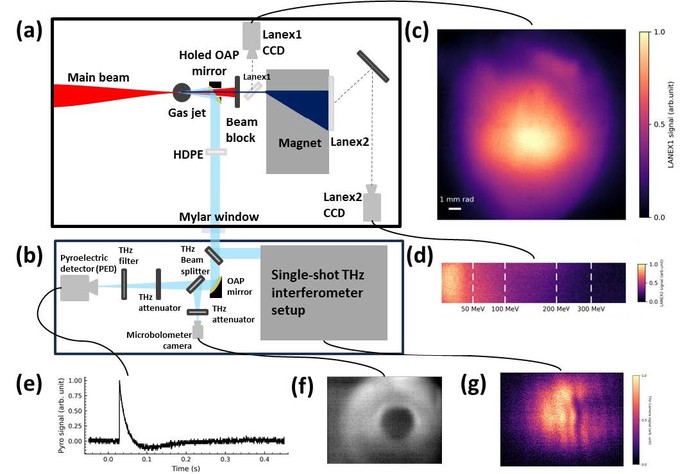
Fig: 1: Overview of the 100-TW LWFA experimental setup (a–b) and representative diagnostic outputs (c–g), including electron beam spatial profile (c), energy spectrum (d), pyroelectric THz signal (e), and THz beam profile (f–g). (Image credit: Pak et al., arXiv:2601.00134)
To capture this phase distribution with the spatial resolution and sensitivity required, the team used the Phasics SID4-HR wavefront sensor. With quadriwave lateral shearing interferometry technology, the SID4-HR retrieves the full phase map of the probe beam in a single acquisition, without the need for reference arms, scanning, or multi-shot averaging.
By scanning across a range of gas backing pressures from 7 to 28 bar and applying Abel inversion to the measured phase maps, the team reconstructed the radially resolved electron density profiles at different operating conditions.
What the Data Shows
The measurements reveal a well-defined plasma structure. Approximately 2 mm above the nozzle orifice, the gas jet forms a stable density plateau roughly 2 mm in width. Within this plateau, the axial electron density scales with backing pressure, ranging from 0.4 × 1018 cm−3 at 7 bar to 1.5 × 1018 cm−3 at 28 bar. The plateau is bounded by steep density gradients on both the upstream and downstream edges.
This is exactly the information needed to anchor the rest of the experimental analysis. The density gradient at the plasma entrance, for instance, is directly relevant to the electron injection dynamics. The plateau width constrains the effective acceleration length. And the absolute density values set the wakefield wavelength, which determines the resonance condition for the drive laser pulse.
Why Single-Shot Matters in Low-Rep-Rate Experiments
One of the less-discussed challenges of high-field laser-plasma physics is the low repetition rate that comes with high-energy laser systems. Under these conditions, any diagnostic that requires multiple acquisitions to build up a reliable measurement is already at a structural disadvantage.
The single-shot capability of the SID4-HR is therefore not a convenience feature, it is a scientific necessity. Each plasma shot is a unique physical event. The density profile on shot N is not necessarily the same as on shot N+1: gas flow conditions fluctuate, backing pressure can drift, and the previous laser pulse may have modified the local gas distribution. A measurement that averages over these variations does not describe any single shot; it describes a statistical ensemble that may never have corresponded to any real physical state.
By capturing a complete, shot-resolved density profile, the diagnostic makes it possible to correlate, on a one-to-one basis, the plasma conditions with the observed electron beam and THz output. This provides one of the most direct routes to physically interpretable data in single-shot experiments.
From Correlation to Physical Interpretation: The Broader Methodological Point
There is a recurring pattern in high-field laser experiments: reproducibility challenges that are attributed to laser instability, but which are actually rooted in uncharacterized plasma conditions. The laser performance is logged shot-by-shot, often in great detail. The plasma density, by contrast, is estimated once per gas pressure setting and assumed constant.
This asymmetry in diagnostic rigor creates a gap between what is measured and what is understood. Energy scaling studies, mechanism identification, and cross-experiment comparisons all require that the plasma conditions be specified at the same level of precision as the laser parameters. Otherwise, what looks like a laser-dependent trend may simply reflect unmeasured density variation.
The IBS study exemplifies what becomes possible when this gap is closed. The quantitative density profiles are not supplementary data, they are structural elements of the argument. They define the physical regime in which the THz scaling laws were measured, and they provide the boundary conditions against which the proposed coherent radiation mechanism can be evaluated.
What This Means for Your Experiment
If you are running LWFA experiments, strong-field THz generation, or any high-power laser-plasma interaction study, the diagnostic approach demonstrated here is directly transferable. Transverse probe wavefront sensing with the SID4-HR provides:
— Quantitative electron density profiles derived from calibrated phase measurements
— Single-shot acquisition, compatible with low-rep-rate laser systems
— Non-perturbative measurement that does not interact with the main laser channel
— Spatially resolved 2D phase maps that capture the full density topology, including gradients
— A directly comparable experimental parameter that can be reported and reproduced across different labs and setups
The principle is simple: if you want your output data to be physically interpretable, your input conditions need to be physically characterized. Plasma density is one of those conditions and it is now measurable with the same rigor as any other experimental parameter.
Explore Wavefront Sensing for Plasma Diagnostics
Phasics develops and manufactures high-resolution wavefront sensors for demanding photonic and plasma diagnostics applications. The SID4-HR is deployed in leading LWFA, ICF, and laser-plasma interaction laboratories worldwide.
Contact our teams to discuss how wavefront-based density diagnostics can be integrated into your experimental setup or follow our technical content series for more case studies from the field.
Reference
Pak T. et al., Generation and characterization of coherent terahertz radiation from 100-TW laser-wakefield acceleration, arXiv:2601.00134 (2025). https://arxiv.org/abs/2601.00134