Phasics
- Wavefront, MTF and QPI measurement solutions
- Products
- Applications
- Markets
- Company
- Contact us
June 23, 2026
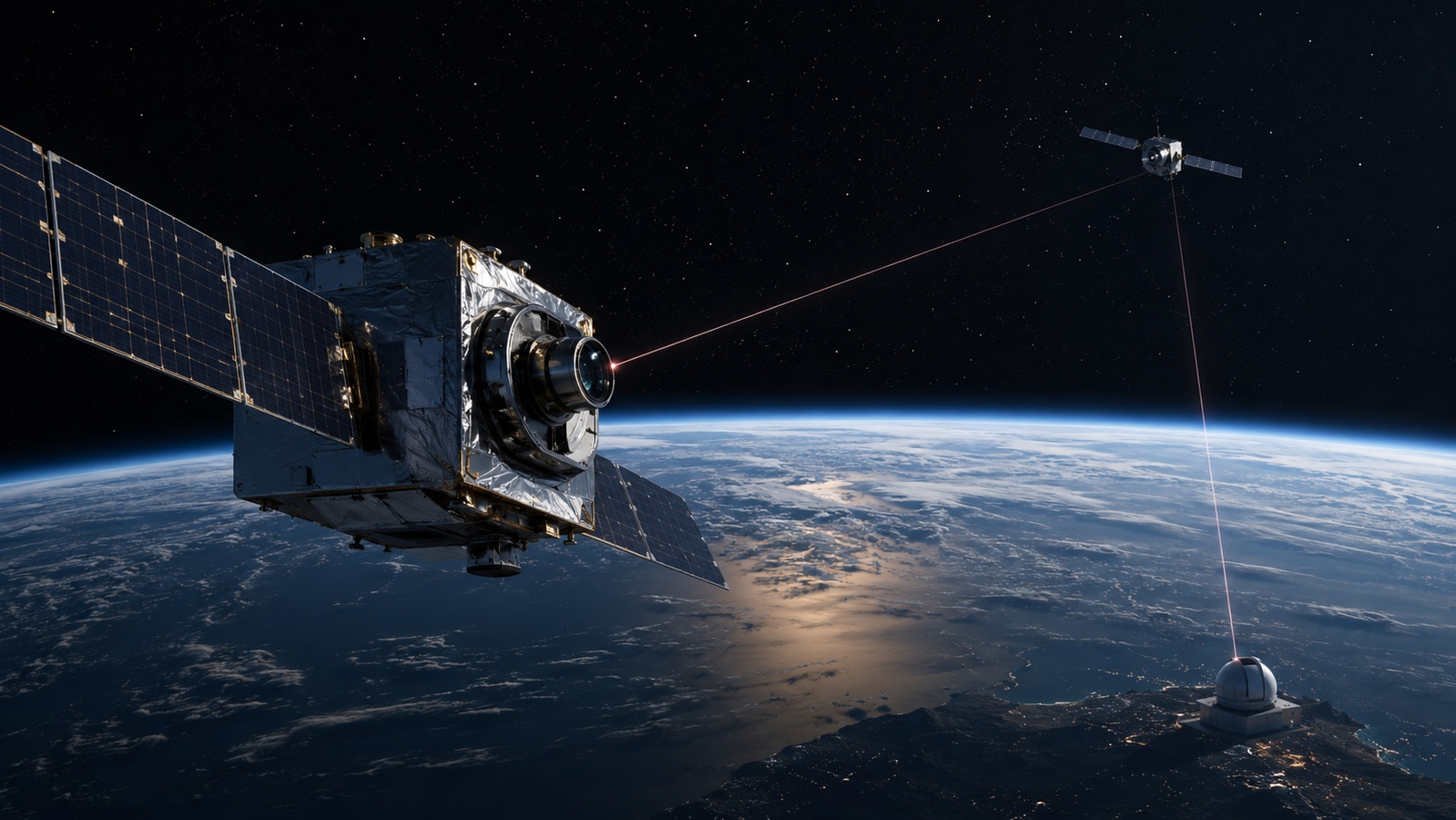
A Phasics technical brief on FSO deployment, manufacturing scale, and the metrology that keeps optical links on target.
SpaceX's IPO and the Satellite Optical Link Moment
SpaceX's long-anticipated public offering arrived in June 2026 with a roughly $1.77 trillion valuation at issuance; Reuters reported that the first trading day pushed SpaceX's market value above $2 trillion[1]. Those numbers reignited capital market attention on low-earth-orbit (LEO) satellite networks and for good reason. Beneath the headline figures, Starlink's technical roadmap has quietly matured into something far more consequential than broadband access: a high-throughput, AI-ready space data infrastructure built on optical inter-satellite links (ISLs) [2].
Alongside SpaceX, Amazon Leo, Kepler Communications, Telesat Lightspeed, and several emerging constellations are accelerating deployment. The question that engineers and investors alike are beginning to ask is not whether satellite laser communications will scale, but how well the industry understands the optical physics that constrains every link in that chain and whether the metrology infrastructure exists to match.
1. From Prototype to Production: The Scale Already in Orbit
Between 2021 and 2022, SpaceX began equipping Starlink satellites with laser inter-satellite links at scale. Rather than remaining a one-off demonstration payload, optical ISLs became part of routine megaconstellation manufacturing and operations. As of June 2026, Starlink had crossed the 10,000-satellite scale; with Starlink describing each satellite as carrying three optical ISLs operating at up to 200 Gbps, the deployed optical terminal count is already in the tens of thousands
SpaceX builds these terminals in-house through vertical integration. The company does not publish terminal production figures, so annual output should be treated as an inference from launch cadence rather than an official statistic. In 2024, SpaceX President Gwynne Shotwell said the company had started selling satellite laser links commercially to other satellite operators under the name 'Plug and Plaser,' with customer discussions underway[3].
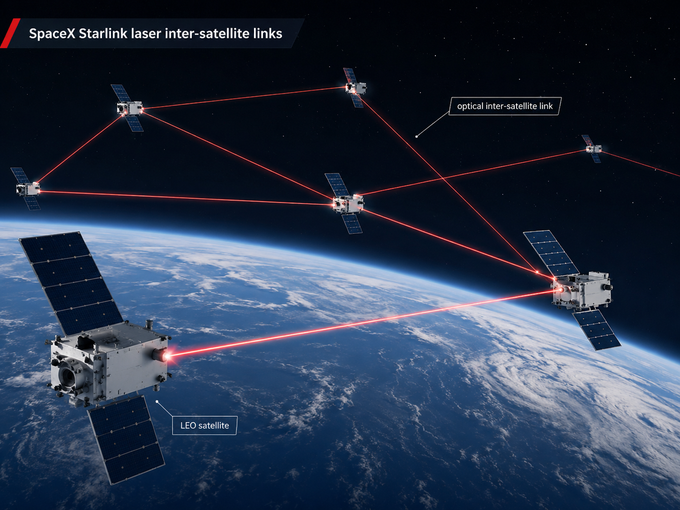
Figure 1. Conceptual illustration of Starlink laser inter-satellite links.
This AI-generated image is based on publicly available information and is intended to illustrate the basic concept of Starlink satellites interconnected through optical inter-satellite links for space-based relay communication.
2. Global Deployment Landscape
Amazon Leo
Amazon Leo, formerly Project Kuiper, demonstrated 100 Gbps optical links between prototype satellites in 2023 and has stated that laser links will be included on every satellite in the constellation[4]. That validates the optical mesh-network architecture, but the program should still be described as moving from validation into deployment rather than as a mature large-scale optical terminal production system.
Kepler Communications
Kepler Communications has validated optical ISLs in orbit and is building toward a real-time data relay network for on-orbit assets. Its terminal supply has been formally confirmed by Tesat, and Kepler has reported optical links between Pathfinder satellites equipped with SDA-compatible Tesat SCOT80 terminals[5].
Telesat Lightspeed
Telesat Lightspeed targets enterprise and government communications markets with a multi-hundred-satellite LEO network using optical ISLs for resilient space networking[6]. Commercial service is now targeted around the end of the first quarter of 2028[7].
Terminal Supply Chain
On the supply side, established terminal manufacturers are transitioning from low-volume engineering units toward higher-cadence production. Examples include Tesat's Backnang facility, Mynaric's CONDOR Mk3 volume-production ramp, and CACI's Orlando space manufacturing and testing facility for optical communications hardware[8].
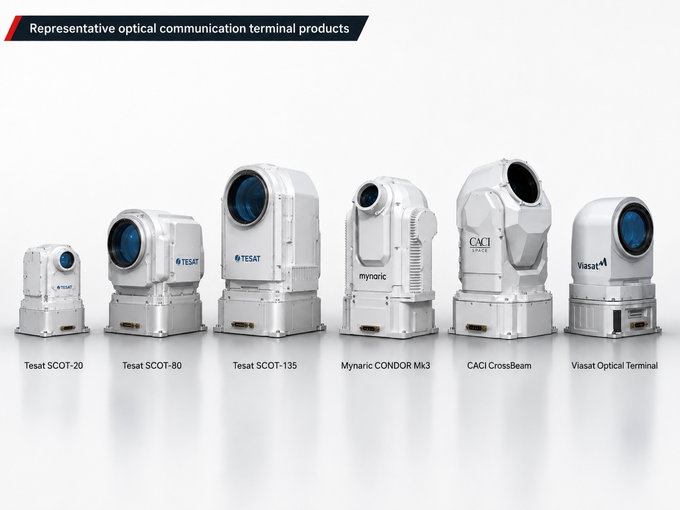
Figure 2. Conceptual overview of representative space optical communication terminal products.
This AI-generated image is based on publicly available information and is intended to illustrate representative space and free-space optical communication terminal products, including the Tesat SCOT series, Mynaric CONDOR Mk3, CACI CrossBeam, and Viasat terminals. It does not represent the official product appearance, dimensional proportions, or industrial design details released by any of these companies.
3. A Candid Look at Production Capacity
The gap between the current global leaders in FSO terminal production reflects the broader maturity gap across the industry.
SpaceX manufactures its ISL terminals through full vertical integration. Based on the number of Starlink satellites deployed and the three-laser terminal architecture disclosed by Starlink, the cumulative in-orbit optical terminal count is already in the tens of thousands. However, SpaceX does not publish a terminal-level production rate, so any annual-output estimate should be labelled explicitly as an inference, not a reported figure.
Tesat, the most established third-party terminal supplier cited in this brief, opened a Backnang production facility in 2024 that the company says can manufacture up to 100 units per month.
In China, domestic organizations have achieved a sequence of in-orbit optical-communication milestones, including Xingyun-2 inter-satellite laser communication validation, Chang Guang Satellite's 100 Gbps inter-satellite and satellite-to-ground laser tests, and Laser Starcom's reported 400 Gbps inter-satellite demonstration[9] [10] [11]. These milestones show rapid technical progress, but they should not be conflated with Starlink-scale serial production.
China's primary broadband constellation programs remain in comparatively early deployment phases against their planned scale. Launch cadence, reusable-launch maturity, and vertical integration remain important constraints when comparing China's ecosystem with SpaceX's integrated launch-and-constellation model.
Note: production-capacity figures outside operator disclosures should be treated as directional industry estimates, not official statistics.
4. What FSO Actually Requires: The Engineering Constraints
Free-space optical communication replaces fiber with open-space laser propagation. A modulated optical beam is generated, collimated through the transmit optics, propagated across free space potentially thousands of kilometers for ISLs, and collected by a receive aperture and detector. The physics that make FSO attractive, high spectral efficiency, narrow divergence, and no RF spectrum licensing are the same physics that make it exacting to build and verify[12].
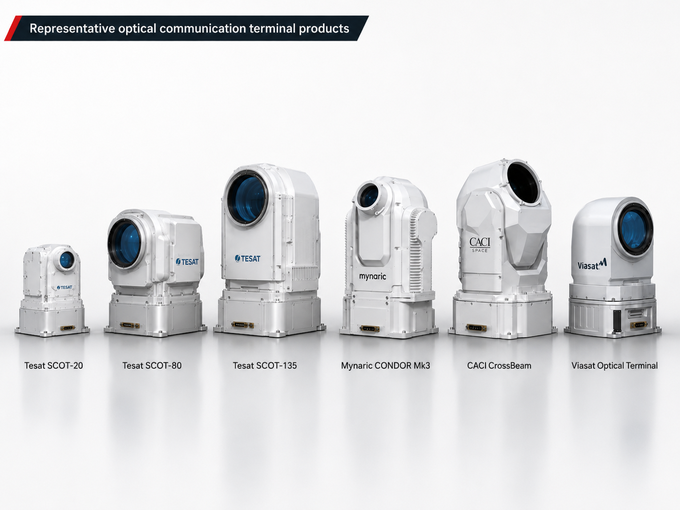
Figure 3. Schematic illustration of FSO communication and the PAT mechanism.
This AI-generated image is based on publicly available information and relevant literature, and is intended to illustrate the basic link architecture of free-space optical communication and the Pointing, Acquisition and Tracking, or PAT, mechanism.
A representative FSO terminal can include a laser source, modulation electronics or optics, collimating and beam-expansion optics, transmit/receive apertures, narrowband filters, detectors, and a pointing, acquisition, and tracking (PAT) subsystem. At its core, FSO is a wavefront engineering problem: any phase error, beam divergence increase, or collimation offset introduced at the transmitter can translate over long propagation distances into measurable received-power loss.
The questions that matter at engineering scale:
→ Is the transmitted beam genuinely collimated at the aperture exit?
→ Has the beam expander introduced astigmatism or defocus?
→ Does the bandpass filter contribute transmitted wavefront error (TWE) at the operating wavelength?
→ Does the full transmit chain meet divergence angle requirements for the link budget?
→ Do wavefront characteristics remain stable under thermal cycling, vacuum, and mechanical stress?
These are not questions that can be settled by design simulation alone. They require direct measurement.
5. Three Levels of Optical Metrology for FSO
Level 1 — Component Characterization
Bandpass filters, windows, transmissive elements, mirrors, and telescope optics all need to be characterized for transmitted or reflected wavefront error before system assembly. Bandpass filters are a commonly overlooked source of TWE: substrate quality, coating stress, and mounting-induced strain can each degrade wavefront quality even in a component that passes spectral specification. Phasics' Kaleo Kit modular configuration supports double-pass wavefront measurement for filters, mirrors, and telescope optics enabling pre-assembly screening that reduces downstream uncertainty during integration.
Level 2 — Subassembly Metrology
The relevant unit here is the functional module: a laser diode plus collimating optics forming a laser module, or a beam expander or compressor forming part of the transmit or receive path. Individual components may pass specification, yet the assembled module can exhibit residual defocus, astigmatism, tilt, or collimation error. Zernike decomposition of the measured wavefront allows engineers to isolate the dominant aberration terms and trace them to specific alignment degrees of freedom, providing direct guidance for assembly correction and design revision. This metrology layer is particularly important for FSO terminal manufacturers and optical module suppliers because it bridges component quality to system-level output and is the point at which repeatable assembly processes are either validated or found wanting.
Level 3 — Full Transmit Beam Verification
At the system level, the measurement target is the complete output beam of the transmit chain. Wavefront error remains relevant, but the directly meaningful system parameters are beam divergence angle, M² beam quality factor, beam waist size and position, intensity distribution, and pointing stability. Divergence angle is the parameter that most directly enters the link power budget. M² quantifies departure from ideal Gaussian propagation; beam waist position determines how the beam evolves along the propagation path; intensity distribution reveals energy concentration anomalies. For large-aperture or full-aperture transmit beam characterization, the KALAS modular solution extends measurement coverage to beam sizes that approach actual system output dimensions. For space and environmental qualification, the SID4-V vacuum-compatible wavefront sensor allows wavefront drift to be monitored continuously under thermal and pressure variation, providing direct evidence of optical terminal stability under representative operating conditions.
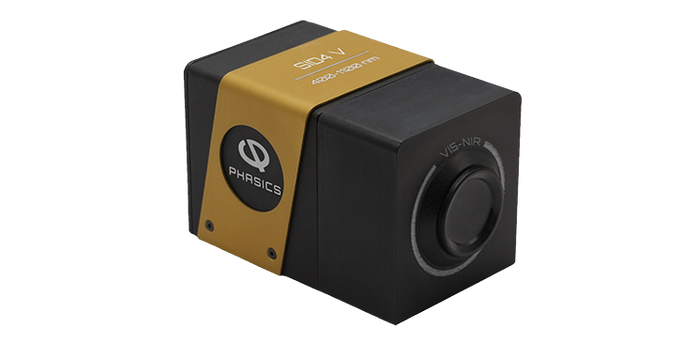
Phasics SID4-V
Phasics sensors acquire phase and intensity in a single measurement frame, without mechanical scanning making them compatible with both laboratory qualification and inline production environments. For 1550 nm and adjacent telecom-band wavelengths, the SID4-SWIR and SID4-SWIR HR cover the relevant near-infrared communication bands; the SID4-eSWIR extends coverage from 1.2 to 2.2 µm for broader spectral range applications.
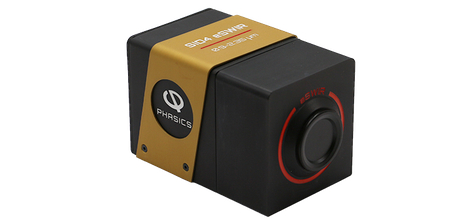
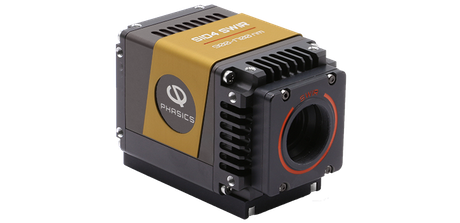
SID4-eSWIR SID4-SWIR
From Lab Demonstration to Repeatable Production
The commercial expansion of Starlink and competing LEO constellations is drawing more engineering teams into FSO terminal development and manufacturing. Market interest, however, eventually resolves into physical reality: every transmitted beam must be shaped, collimated, and verified; every filter, telescope module, and transmit aperture must be measured at operating wavelength and under representative environmental conditions.
Wavefront metrology is the mechanism through which beam quality moves from a design assumption to a measured, verified, and controlled engineering parameter the step that separates a laboratory demonstrator from a product capable of repeatable production and stable deployment.
For inquiries about FSO terminal metrology, optical ISL wavefront characterization, transmitted wavefront error (TWE) measurement at 1550 nm, or beam quality analysis for space optical systems, contact Phasics (an Exosens Group company).
[1] Reuters, “Musk’s SpaceX prices record $75 billion IPO at $135 a share,” June 11, 2026; Reuters, “SpaceX surges past $2 trillion in Nasdaq debut,” June 12, 2026.
[2] Starlink official technical material, Starlink inter-satellite laser links and satellite communication technology.
https://starlink.com/technology
[3] Reuters, “SpaceX says it plans to sell satellite laser links commercially,” March 19, 2024.
https://www.reuters.com/technology/space/spacex-says-plans-sell-satellite-laser-links-commercially-2024-03-19/
[4] Amazon official material, “Project Kuiper completes successful space laser communication tests,” December 2023.https://www.aboutamazon.com/news/innovation-at-amazon/amazon-project-kuiper-oisl-space-laser-december-2023-update
[5] Tesat official material, “Kepler validates Tesat optical communication terminals in orbit.”
https://www.tesat.de/news/blog/942-kepler-validates-tesat-optical-communication-terminals-in-orbit-for-kepler-network
[6] Tesat official material, “Tesat selected by MDA Space to deliver optical inter-satellite link terminals for Telesat Lightspeed.”
https://www.tesat.de/news/press/941-tesat-selected-by-mda-space-to-deliver-oisl
[7] Via Satellite, “Telesat’s Lightspeed Service Launch Slips to 2028,” March 17, 2026.
https://www.satellitetoday.com/finance/2026/03/17/telesats-lightspeed-service-launch-slips-to-2028/
[8] Tesat official material, “Tesat opens series production facility for satellite laser communication terminals.”
https://www.tesat.de/news/press/1003-kretschmann-opens-series-production-in-backnang
[9] China National Space Administration, “China’s satellite IoT constellation achieves a first breakthrough in inter-satellite laser communication,” August 17, 2020.https://www.cnsa.gov.cn/n6758823/n6758838/c6809992/content.html
[10] Science and Technology Daily, “China’s first 100 Gbps satellite-to-ground laser communication test completed,” December 28, 2024.https://www.stdaily.com/web/gdxw/2024-12/28/content_280059.html
[11] “2025 Commercial Aerospace: Ten New Tracks — Space Laser Communication Terminals.”
[12] Y. Kaymak, R. Rojas-Cessa, J. Feng, N. Ansari, M. Zhou, and T. Zhang, “A Survey on Acquisition, Tracking, and Pointing Mechanisms for Mobile Free-Space Optical Communications,” IEEE Communications Surveys & Tutorials, 2018.https://web.njit.edu/~rojasces/publications/2018kayrocomst.pdf