Phasics
- Wavefront, MTF and QPI measurement solutions
- Products
- Applications
- Markets
- Company
- Contact us
Feb. 13, 2026
As data volumes continue to grow worldwide, long term and energy efficient storage technologies are gaining renewed attention. Among emerging approaches, silica glass-based multi-dimensional optical storage has attracted significant interest due to its potential for high stability and durability. A recent study demonstrated storage densities reaching 7.5 terabytes per disc by transitioning from infrared to 343 nm ultraviolet (UV) femtosecond laser writing.
Precision at the nano scale
Using shorter wavelengths (UV) allows for much smaller voxels, significantly increasing storage density. However, this precision comes with a challenge: how do you characterize and stabilize the birefringent structures induced by such high energy pulses? Traditional qualitative imaging is no longer enough.
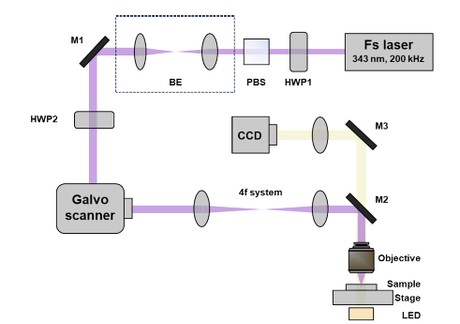
Figure 1. UV femtosecond laser writing setup Image source: Figures adapted from Optics Express, Vol. 32, No. 26, 46140–46156 (2024).
The system relies on high NA focusing (NA = 0.95) to generate tightly confined birefringent voxels inside silica glass, enabling high density multi-dimensional encoding.
Quantitative Wavefront Sensing
To better characterize the physical mechanisms behind this 7.5 terabytes achievement, researchers utilized Phasics SID4-HR camera. Based on Quadriwave Lateral Shearing Interferometry (QWLSI), SID4-HR provided:
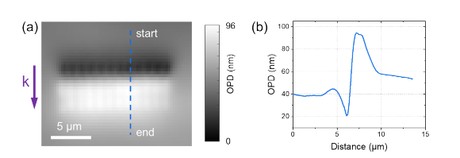
Figure 2. Optical phase mapping of UV laser-written voxels Image source: Figures adapted from Optics Express, Vol. 32, No. 26, 46140–46156 (2024).
The phase maps reveal a characteristic spatial transition: negative optical path change at the voxel head and positive change at the tail, directly correlating with cavitation and densification mechanisms inside the material.
From Physical Mechanism to Data Encoding
Precise control over birefringence enables multi-bit encoding within a single voxel.
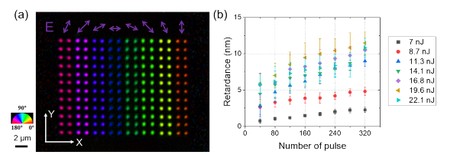
Figure 3. Birefringent voxel arrays and slow-axis orientation encoding Image source: Figures adapted from Optics Express, Vol. 32, No. 26, 46140–46156 (2024).
By combining slow axis orientation and retardance modulation, researchers achieved 3 bit encoding per voxel with high readout accuracy.
Why Metrology Matters for the Future of Storage?
For 5D glass storage to move from the lab to industrial scale, consistency is king. Phasics technology transforms the "black box" of laser matter interaction into a quantifiable engineering process. By ensuring every bit is etched with perfection, we are helping pave the way for data that lasts for centuries.
Contact our experts to learn more about SID4-HR for material inspection applications.
Reference: Optics Express, Vol. 32, No. 26, 46140–46156 (2024)